Non-Invasive Water Leak Diagnosis for Historic & Modern Buildings
Water leaks in Greenwich Village are rarely straightforward. In a neighborhood defined by historic 19th-century Greek Revival and Italianate townhouses, pre-war co-operative apartment buildings, and converted industrial lofts, plumbing networks are often concealed beneath layers of plaster, hardwood subflooring, and masonry fireproofing. When moisture surfaces on a living room ceiling or behind a bathroom vanity, tracing its true origin requires specialized diagnostic tools rather than guessing and tearing open decorative walls.
Whether you are dealing with a sudden ceiling leak repair Greenwich Village Manhattan issue, a mysterious damp spot in a hallway, or an intermittent water leak from upstairs apartment Greenwich Village Manhattan, NY Plumbing provides systematic, non-invasive diagnostic evaluations. We isolate the exact source of water intrusion to protect architectural finishes, prevent mold proliferation, and give property owners, boards, and superintendents clear, actionable documentation before repairs begin.
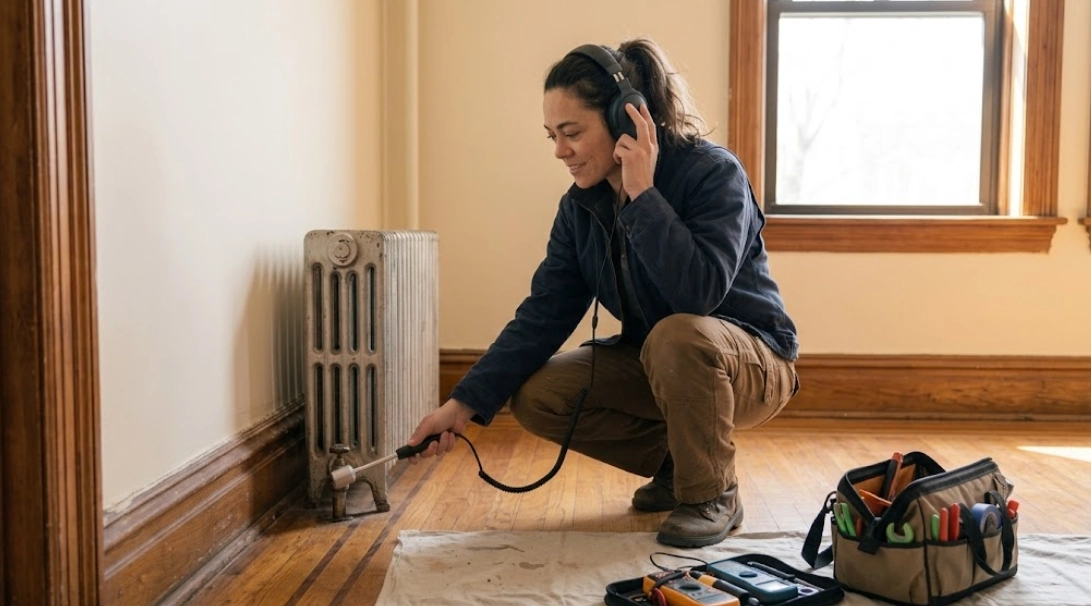
Advanced acoustic detection discs and thermal imaging equipment isolate concealed pipe leaks behind historic Greenwich Village walls without destructive demolition.
Signs You May Have a Hidden Water Leak
Concealed leaks often progress quietly for days, weeks, or even months before water breaks through finished surfaces. Identifying early warning signals can prevent severe structural deterioration, plaster collapse, and expensive restoration:
- Unexplained Staining and Discoloration: Yellow, brown, or dark rings expanding across ceiling plaster or drywall, often originating near pipe chases or lighting fixtures.
- Bubbling, Peeling Paint or Warped Woodwork: Moisture trapped behind latex paint creates blisters, while hardwood parquet floors cup, buckle, or darken near baseboards.
- Persistent Musty Odors: An earthy, damp odor that lingers in closets, utility spaces, or bathrooms even after thorough cleaning indicates hidden mold or damp insulation.
- Faint Hissing or Dripping Sounds: Hearing rushing or dripping water behind walls when all apartment faucets, showers, and appliances are completely turned off.
- Unexplained Drop in Water Pressure: A noticeable loss of hot or cold water flow at multiple fixtures can indicate an active supply line rupture or pinhole break.
- Subfloor Dampness: Cool, damp patches on bathroom tile floors or carpeting without any surface spill.
Noticing Damp Spots or Ceiling Stains? Speak Directly With a Technician
Don't wait for plaster to collapse or hardwood floors to warp. Connect directly with NY Plumbing to evaluate your hidden leak symptoms.
Call (315) 202-8009Why Leaks Can Be Difficult to Trace in Greenwich Village Apartments
Water follows the path of least mechanical resistance, which is rarely a straight vertical line. In multi-family Manhattan buildings, diagnosing apartment leak detection Greenwich Village Manhattan challenges requires understanding complex structural assemblies:
- Horizontal Water Migration Across Subfloors & Concrete Arches
- A leaking shower valve or radiator branch pipe on the third floor can travel twenty feet across concrete floor slabs, terracotta structural arches, or wooden floor joists before finding a conduit penetration or ceiling seam to drip through on the second floor. The visible ceiling stain is often far removed from the actual pipe breach.
- Shared Building Risers and Interconnected Pipe Chases
- Pre-war buildings near Washington Square Park and Bleecker Street often feature shared vertical pipe chases carrying domestic cold water, hot water recirculation lines, steam heating returns, and cast-iron waste stacks. A leak occurring three floors above can run down the exterior of a vertical riser pipe and emerge in an unrelated apartment below.
- Intermittent Usage vs. Continuous Pressure Leaks
- Pressurized water supply lines leak constantly, 24 hours a day, causing stains to expand steadily. In contrast, drainage lines, shower pan membranes, or tub overflows leak only when specific plumbing fixtures are actively used, creating confusing intermittent drips that appear and vanish unpredictably.
Our Step-by-Step Leak Diagnostic Process
Locating a hidden water leak detection Greenwich Village Manhattan issue requires a methodical, step-by-step diagnostic sequence rather than random guessing:
- Symptom Review and Building Architecture Analysis: We examine the physical stains, discuss moisture timing, review building vintage, and determine whether adjacent or upstairs apartments are involved.
- Non-Invasive Moisture Mapping: Calibrated non-destructive pinless moisture meters scan drywall, plaster, tile, and wood flooring to map the boundary of active moisture concentration.
- Infrared Thermal Imaging: High-resolution thermal cameras detect subtle surface temperature differentials caused by evaporative cooling or escaping hot water lines, outlining concealed pipe runs and moisture plumes behind walls.
- Acoustic Listening & Pressure Isolation: Sensitive electronic ground microphones and pipe listening probes amplify the high-frequency acoustic vibrations created by water escaping under pressure through pinholes or cracked joints.
- Systematic Pressure Testing: Individual plumbing loops, supply branches, or fixture supplies are isolated and pressure-tested with gauges to confirm which specific pipe line is failing to hold pressure.
- Drain & Fixture Flood Testing: If supply lines hold pressure, dye testing and controlled drain pan flood tests isolate cracked bathtub traps, leaking shower pans, or compromised escutcheons.
- Actionable Report & Repair Recommendation: Once the precise failure point is pinpointed, we clearly explain the findings and recommend targeted pipe leak repair or localized access.
Managing In-Wall and Upstairs Apartment Leaks
Discovering a leak in wall detection Greenwich Village Manhattan problem often requires coordination across multiple parties. In cooperative buildings and condominiums, clear boundaries exist between shareholder/unit-owner responsibilities (typically fixture branch lines inside the apartment) and building corporation responsibilities (the main vertical risers and common structural chases).
When water drips from a ceiling, our diagnostic findings help building superintendents, property managers, and unit owners determine whether the leak originates from an individual shareholder's tub trap, an aging branch line, or a shared common building pipe. We provide clear, objective technical descriptions that facilitate fast management approval and insurance documentation.
Need Local Diagnostic Support Near West Village or Meatpacking?
From brownstones on historic side streets to modern loft buildings, we diagnose plumbing issues across Greenwich Village and adjacent West Village corridors.
Call (315) 202-8009Leak Detection vs. Pipe Repair: Understanding the Distinction
It is important for property owners to understand the distinction between leak detection and pipe repair. Leak detection is the specialized investigative process of pinpointing the location and cause of hidden water without widespread destructive demolition. Once our investigation determines the precise failure point, physical access can be cut in a small, discreet location (such as a 6x6-inch opening) rather than stripping an entire tiled wall. At that point, our team or building maintenance can perform permanent pipe soldering, joint repiping, or valve replacement with minimal property disruption.
Comprehensive Plumbing Services for Greenwich Village Buildings
In addition to specialized leak detection, NY Plumbing provides comprehensive mechanical and plumbing services designed for the unique infrastructure of Manhattan properties:
Pipe Leak Repair
Targeted repairs for pinhole copper leaks, corroded threaded joints, and burst water pipes once leak locations are confirmed.
Repiping
Replacing deteriorating galvanized steel lines and failing riser stacks with durable modern copper systems to eliminate recurring leaks.
Water Heater Repair
Diagnostics and repairs for leaking residential storage tanks, faulty gas burner controls, and indirect boiler storage vessels.
Boiler Repair
Restoring steam heat and hydronic hot-water boilers, curing no-heat calls, and replacing leaking safety relief valves across Village properties.
Gas Line Repair & Inspection
Licensed gas piping pressure testing, leak isolation, appliance installations, and NYC Local Law 152 compliance reviews.
Drain Cleaning
Motorized heavy-duty snaking and camera inspections for sluggish kitchen stacks, bathroom clogs, and main line stoppages.
Backflow Testing
Annual certified backflow preventer testing, device rebuilds, and NYC DEP compliance filings to safeguard drinking water supplies.
Local Neighborhood Coverage Around Greenwich Village
Our core service territory is centered in Greenwich Village, extending through historic residential blocks near Bleecker Street, Washington Square Park, and New York University (NYU). In addition, we readily provide leak detection near West Village and leak detection near Meatpacking District, as well as surrounding neighborhoods including SoHo, Chelsea, and the East Village. For full geographic details, please explore our dedicated Service Areas page.
Frequently Asked Questions About Leak Detection
Common warning signs of a concealed in-wall leak include peeling paint, bubbling wallpaper, warped baseboards, persistent damp or musty odors, a faint hissing sound when all fixtures are turned off, or an unexplained drop in domestic water pressure. Thermal imaging and acoustic sensors help verify moisture presence before opening drywall or plaster.
Yes. Water in multi-story pre-war and post-war buildings frequently travels horizontally along subfloors, concrete slabs, or structural joists before dripping through a lower ceiling. Through systematic isolation of branch lines, fixture testing, and non-invasive moisture tracing, the precise unit and plumbing component responsible can be established.
No. Non-invasive electronic leak detection uses sensitive acoustic listening discs, infrared thermal imaging, and digital moisture meters to scan surfaces externally. While targeted access may ultimately be needed to perform a pipe repair, non-invasive detection prevents unnecessary demolition across multiple rooms.
Place a bucket beneath the affected area, move furniture and electrical cords away, and avoid touching sagging plaster or light fixtures. Alert your upstairs neighbor and building superintendent immediately so they can check for running fixtures or shut off branch supply lines, then call NY Plumbing to evaluate the source.
It is helpful to know whether the building is a co-op, condo, rental, or private townhouse, whether the water drips continuously or only during specific times (like after a shower), if neighboring units are accessible, and whether you have access to local shut-off valves.